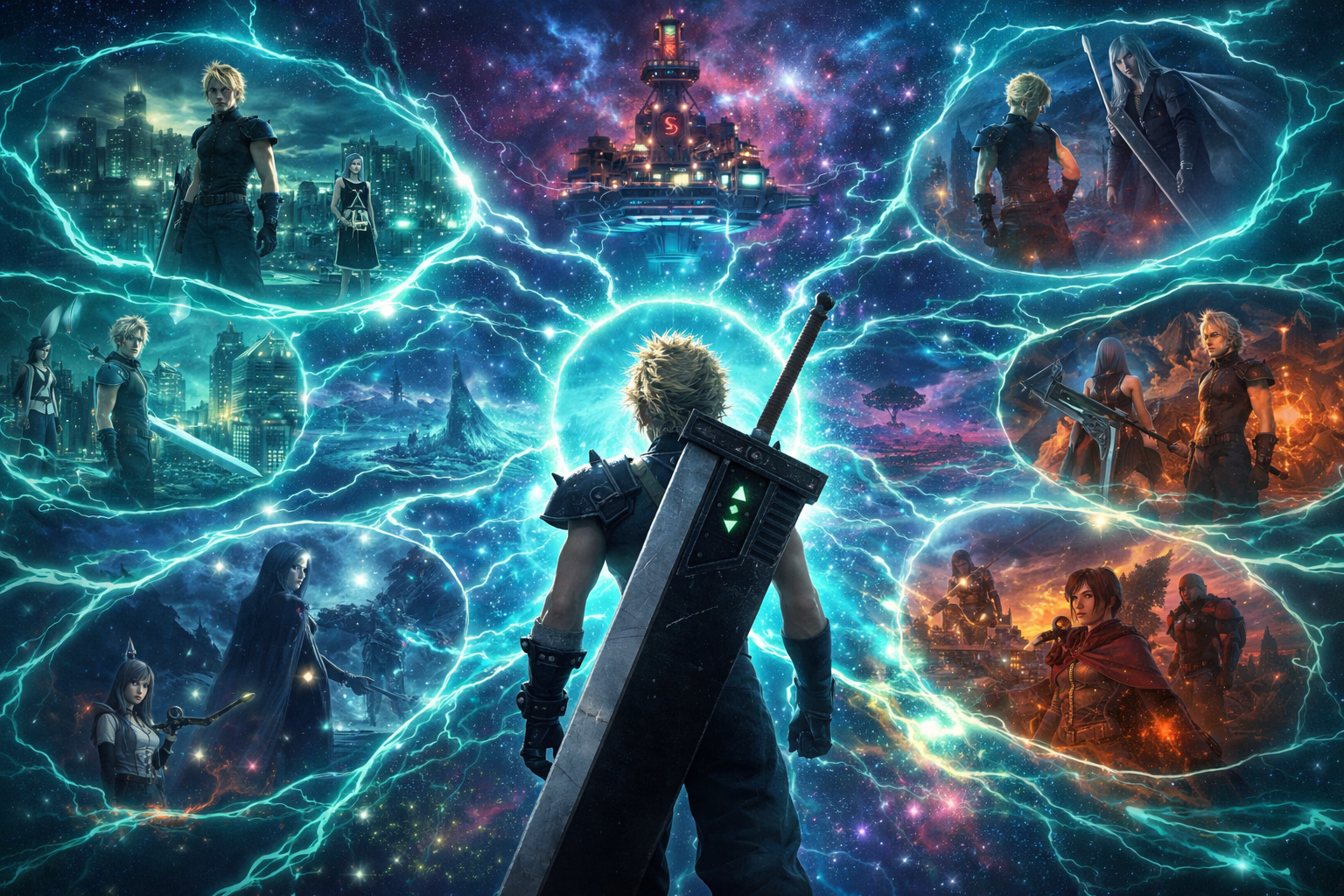
Ever since the release of Final Fantasy VII Rebirth, fans have been asking one question that refuses to go away: Is this still a remake… or something much bigger?
What began with Final Fantasy VII Remake as a reimagining of a classic has evolved into something far more complex. Rebirth expands the narrative beyond a simple retelling, introducing altered events, layered storytelling, and strong hints that multiple realities may be at play.
This isn’t just nostalgia — it’s a bold narrative shift that could redefine the entire Final Fantasy VII saga.
A Story That No Longer Follows One Timeline
At its core, Rebirth follows Cloud and his companions on a journey that feels familiar — but not identical — to the original Final Fantasy VII.
Players quickly notice that:
- Certain events occur differently than expected
- Familiar story beats are rearranged
- Characters behave with unusual awareness
- New elements challenge the idea of a fixed destiny
These deviations suggest something intentional. Rather than retelling the same story, the game appears to be exploring what happens when fate itself is disrupted.
The Whispers: Guardians of Destiny
One of the most important narrative elements carried over from Remake is the presence of the Whispers — mysterious, ghost-like entities.
They seem to:
- Intervene when events deviate from the original timeline
- Push characters back toward predetermined outcomes
- Act as enforcers of fate
In Remake, the Whispers attempt to preserve the original storyline. But once they are confronted and defeated, their influence weakens — and that’s where things begin to change dramatically.
If fate is no longer controlled, then the world is no longer bound to a single timeline.
Zack Fair: The Strongest Multiverse Clue
Perhaps the clearest indication of multiple timelines comes from Zack Fair.
In the original story, Zack’s death is a defining moment that shapes Cloud’s identity. However, in the Remake and Rebirth continuity:
- Zack survives his final battle
- He continues toward Midgar with Cloud
- His storyline unfolds separately from the main narrative
This creates a contradiction that cannot be explained within a single timeline. The most logical explanation is that Zack exists in a parallel reality — one where events unfolded differently.
Parallel Timelines: A Dual Narrative Structure
Many fans believe that Rebirth presents two simultaneous timelines:
Timeline One (Cloud’s Journey)
- Follows a structure similar to the original story
- Includes familiar characters and locations
- Features subtle but important deviations
Timeline Two (Zack’s Reality)
- Zack survives and continues his journey
- The world appears altered
- Events do not align with Cloud’s timeline
These timelines appear to exist alongside each other, potentially influencing or intersecting in ways that are not yet fully understood.
Sephiroth: A Villain Beyond Time
Another key piece of the multiverse theory involves Sephiroth.
Unlike other characters, Sephiroth behaves as though he has knowledge beyond the current timeline. He seems to:
- Anticipate events before they happen
- Manipulate outcomes across different realities
- Exist outside the normal flow of time
This suggests that Sephiroth may not be bound to a single timeline at all. Instead, he could be operating across multiple realities, attempting to reshape destiny itself.
The Lifestream and Interconnected Realities
The Lifestream — the spiritual energy that connects all life — may serve as the bridge between timelines.
Possible interpretations include:
- It holds memories of multiple realities
- It allows characters to experience alternate outcomes
- It connects past, present, and future simultaneously
This could explain the visions, emotional echoes, and moments of déjà vu experienced by characters throughout the game.
What’s New in Rebirth Compared to Remake?
While Remake introduced the idea of fate and narrative deviation, Rebirth expands these ideas significantly.
1. Broader World Design
Players are no longer confined to Midgar. The world opens up, offering more exploration and environmental storytelling.
2. Stronger Multiverse Hints
Zack’s continued presence and narrative contradictions suggest multiple timelines are central to the story.
3. Deeper Character Development
Cloud’s identity becomes more unstable, while Aerith appears more aware of the nature of fate and reality.
4. Less Predictable Storytelling
Events no longer follow a fixed structure, keeping players constantly guessing.
In simple terms:
Remake introduced the concept of breaking fate. Rebirth explores the consequences of that decision.
Is This Still a Remake — or a Sequel?
Traditionally, a remake retells an existing story with modern visuals and updated gameplay. However, Rebirth challenges that definition.
Instead of repeating the past, it:
- Expands the original narrative
- Reinterprets key events
- Introduces new possibilities through timeline divergence
This has led many to believe that the trilogy is actually a continuation of the original story — not a replacement.
What Could Happen Next?
With one more installment expected, the multiverse theory opens up several possibilities:
Timeline Convergence
Different realities may merge into a single outcome.
Alternate Endings
Players could influence which timeline becomes definitive.
Character Crossovers
Zack and Cloud may directly interact across timelines.
Reimagined Iconic Moments
Key events from the original game may play out differently — or not occur at all.
Why the Multiverse Theory Matters
The introduction of multiple timelines changes how players engage with Final Fantasy VII Rebirth.
It transforms the experience into:
- A mystery rather than a predictable story
- A reinterpretation instead of a simple remake
- A narrative that challenges expectations
For longtime fans, this creates both excitement and uncertainty — because nothing is guaranteed anymore.
Final Thoughts: A Bold New Direction
Whether you fully embrace the multiverse theory or remain skeptical, one thing is clear:
Rebirth is not a traditional remake.
It’s a bold reinvention of a beloved story, blending nostalgia with innovation. By introducing alternate timelines, fate-defying characters, and layered storytelling, Square Enix has created a narrative that feels both familiar and entirely new.
The original Final Fantasy VII told a story about saving the planet.
Rebirth may be telling a story about reshaping destiny itself.
And if this theory holds true, the final chapter could redefine not just the series — but how remakes are approached across the entire gaming industry.