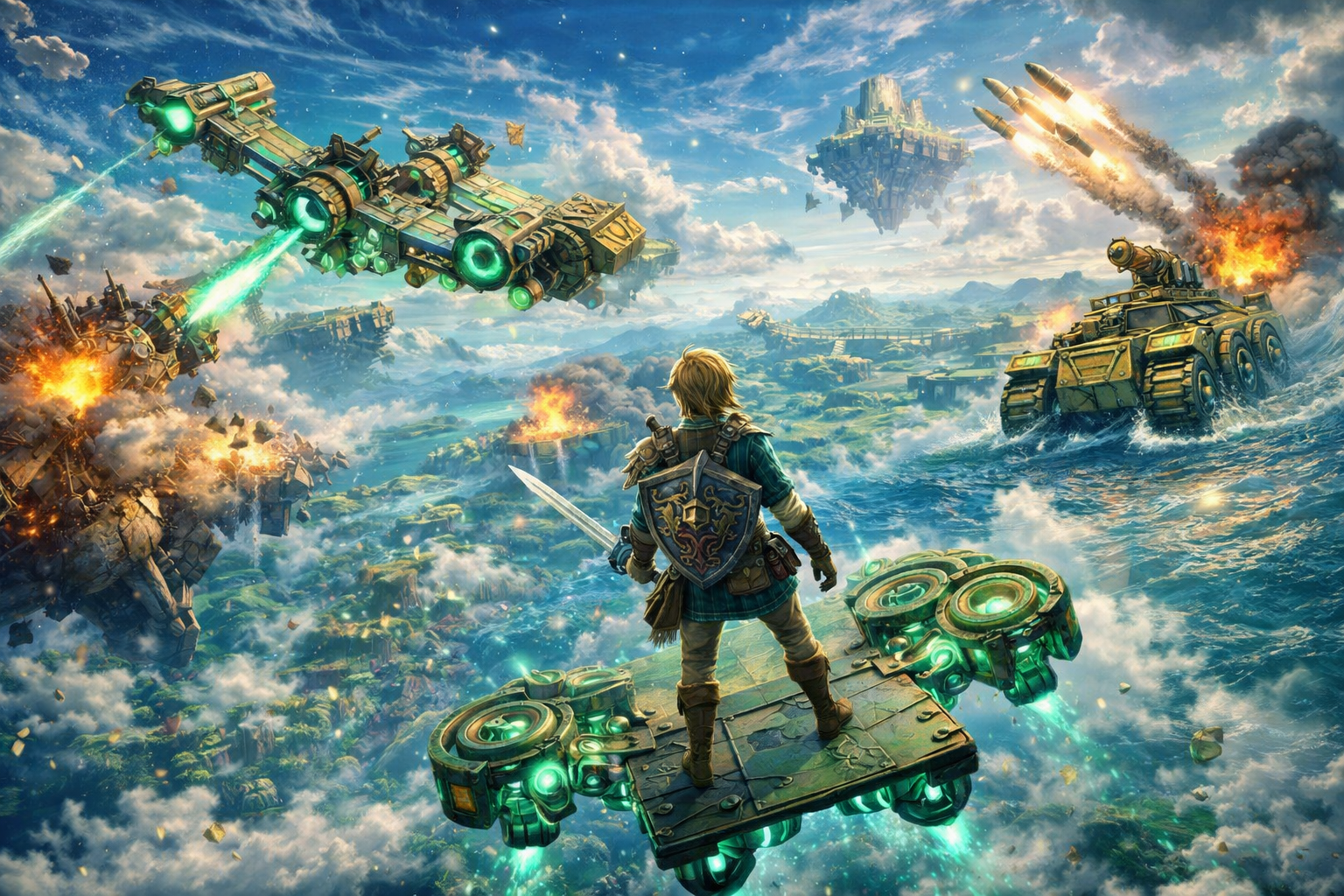
When The Legend of Zelda: Tears of the Kingdom launched, most players expected a refined version of the classic Zelda formula — exploration, puzzles, and combat. Instead, what they got was something far more groundbreaking: a physics-driven sandbox that allows players to build machines capable of completely redefining how the game is played.
Within weeks, the community began creating everything from flying warships to automated combat drones. These creations don’t just enhance gameplay — they often break it in ways that are both fascinating and intentional.
This isn’t just a game anymore.
It’s a creative engine.
The Core of the Chaos: Ultrahand and Zonai Technology
At the heart of this innovation lies the Ultrahand ability, which allows players to pick up, rotate, and attach objects freely in the environment. Combined with Zonai devices — such as fans, rockets, wheels, and energy cells — players can construct fully functional machines.
This system transforms Hyrule into a giant playground where physics, creativity, and experimentation collide. Unlike traditional puzzle mechanics, there is rarely a single “correct” solution. Instead, players are encouraged to invent their own.
1. Flying Combat Machines
One of the most popular inventions among players is the flying combat machine — essentially a homemade drone.
By combining fans for lift, steering sticks for control, and beam emitters for offense, players have created aerial vehicles that can:
- Hover above enemy camps
- Automatically attack enemies
- Clear entire areas without direct combat
These machines significantly reduce the challenge of combat, allowing players to bypass traditional fighting mechanics altogether.
2. Infinite Flight and Hover Bikes
Traversal in the game is designed to be strategic, requiring stamina management, climbing, and environmental awareness. However, players quickly discovered ways to bypass these limitations.
Simple, efficient builds — often called “hover bikes” — use minimal parts to achieve near-perfect balance and energy efficiency. These machines allow players to:
- Travel across the entire map with ease
- Reach high-altitude areas effortlessly
- Skip puzzles and terrain challenges
What was meant to be a journey becomes a shortcut.
3. Armored Tanks and Ground Vehicles
Not all machines take to the skies. Some players prefer brute force on the ground.
Using wheels, stabilizers, and mounted weapons, players have built tank-like vehicles capable of:
- Crushing enemies on impact
- Withstanding heavy damage
- Delivering continuous firepower
These vehicles turn difficult battles into one-sided encounters, shifting the gameplay from skill-based combat to mechanical dominance.
4. Physics Launch Systems
Perhaps the most unexpected creations come from players experimenting with the physics engine itself.
By stacking objects or combining springs and rockets, players have developed launch systems that can:
- Propel Link across vast distances
- Skip entire sections of the map
- Reach unintended locations
These aren’t always intentional features — but they demonstrate how flexible and reactive the game’s physics system truly is.
5. Automated Farming Machines
Beyond combat and exploration, some players have focused on efficiency.
Automated machines are being used to:
- Farm resources with minimal effort
- Defeat enemies repeatedly for loot
- Collect materials faster than intended
This reduces the need for grinding and changes how players interact with the game’s economy.
Why These Machines “Break” the Game
The term “breaking the game” might sound negative, but in this case, it’s more of a compliment.
These creations challenge the intended design in several ways:
- They reduce difficulty in combat and puzzles
- They allow players to bypass progression systems
- They disrupt resource balance
- They create unpredictable outcomes
And yet, none of this feels like cheating — because the game fully allows it.
A Shift in Player Mindset
Traditionally, players approach games by asking:
“How do I solve this puzzle?”
In Tears of the Kingdom, the question becomes:
“What can I build to bypass or redefine this puzzle?”
This shift has transformed players into creators. Instead of following the game’s rules, they experiment with them — and sometimes completely ignore them.
Tears of the Kingdom vs Breath of the Wild: What’s Changed?
To fully understand this evolution, it helps to compare it with its predecessor.
Building Mechanics
Breath of the Wild: Limited interaction with objects
Tears of the Kingdom: Full construction system using Ultrahand
Problem Solving
Breath of the Wild: Multiple solutions, but within defined limits
Tears of the Kingdom: Nearly unlimited solutions driven by creativity
Gameplay Freedom
Breath of the Wild: Encouraged exploration
Tears of the Kingdom: Encourages invention and experimentation
The addition of building mechanics fundamentally changes how players engage with the game world.
Nintendo’s Unique Approach: Freedom Over Restriction
Most developers would patch out exploits or limit player behavior to preserve balance. But Nintendo has taken a different approach.
Instead of restricting creativity, the game embraces it.
Players are encouraged to:
- Experiment with systems
- Combine mechanics in unexpected ways
- Discover new solutions beyond developer intent
This philosophy turns the game into a shared experience where the community continuously pushes the boundaries of what’s possible.
The Rise of Community Innovation
One of the most fascinating aspects of Tears of the Kingdom is how the community interacts with it.
Players are:
- Sharing blueprints online
- Improving each other’s designs
- Competing to create the most efficient or outrageous machines
This has created an entirely new layer of gameplay — one that exists outside the game itself.
Final Thoughts: When a Game Becomes a Sandbox of Ideas
The Legend of Zelda: Tears of the Kingdom is more than just an open-world adventure. It’s a system that empowers players to think differently.
The machines that “break” the game are not flaws — they are proof of how deep and flexible the mechanics truly are.
By giving players the tools to experiment freely, the game transforms them from problem-solvers into inventors.
And in a world like Hyrule, where creativity has no limits, the most powerful weapon isn’t a sword or shield.
It’s imagination.